

 Membergate

Why Prioritize Your Business Backup Plan?
Why You Must Prioritize
Your Business Backup Plan
Post #4
Your Business Backup Plan
Post #4
How do you tackle the market's unpredictable twists and turns?
If an unforeseen downturn or abrupt shift disrupts your business,
having a backup plan can be the difference between sinking
and swimming.
If an unforeseen downturn or abrupt shift disrupts your business,
having a backup plan can be the difference between sinking
and swimming.
now is the time to make one!
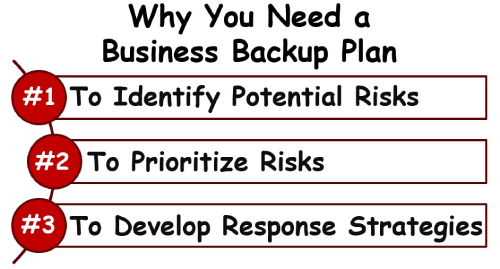
**#1 - Identify Potential Risks to Your Business!
>>> Do you know the most significant potential risks to your business? The first step in formulating a backup plan is understanding the risks you must prepare for.
For a few examples, these might include:
(a) - Financial uncertainties - such as a sudden economic downturn
or a change in interest rates that affect your ability to secure funding
(b) - Technological failures like cyberattacks, server outages, or innovations
that change the marketing landscape
(c) - Operational issues such as supply chain changes, equipment failures,
software problems, or regulatory changes
(d) - Changes in the market, like a competitor rolling out a cheaper version
of your product or a change in consumer tastes
(a) - Financial uncertainties - such as a sudden economic downturn
or a change in interest rates that affect your ability to secure funding
(b) - Technological failures like cyberattacks, server outages, or innovations
that change the marketing landscape
(c) - Operational issues such as supply chain changes, equipment failures,
software problems, or regulatory changes
(d) - Changes in the market, like a competitor rolling out a cheaper version
of your product or a change in consumer tastes
(e) - Legal risks, including lawsuits from customers or other businesses or
unexpected regulatory changes that affect your business
unexpected regulatory changes that affect your business
(f) - Risks related to human resources include increasing employee
turnover rate or issues due to inadequate skills and training
**#2 - Prioritize Risks (Use the chart below to help)
turnover rate or issues due to inadequate skills and training
**#2 - Prioritize Risks (Use the chart below to help)
>>> Contingency planning involves identifying risks, prioritizing
them, assessing their potential impact, and creating Plan B's to
mitigate, counteract, or adapt to them if they occur.
Here are some things to consider to help you prioritize risks:
>>> Impact on your business. The impact could be financial, reputational,
or operational. Take into account how significant the impact would be.
>>> Probability and frequency. Assess the likelihood of each risk occurring
and whether it can happen repeatedly and, if so, how often. A highly
probable or frequent issue could be more damaging to your business
than one with a severe impact.
>>> Risk tolerance. Evaluate your organization's ability to handle each risk.
There may be some that are easier to accept than others. You should
prioritize those that aren't.
>>> Impact on your business. The impact could be financial, reputational,
or operational. Take into account how significant the impact would be.
>>> Probability and frequency. Assess the likelihood of each risk occurring
and whether it can happen repeatedly and, if so, how often. A highly
probable or frequent issue could be more damaging to your business
than one with a severe impact.
>>> Risk tolerance. Evaluate your organization's ability to handle each risk.
There may be some that are easier to accept than others. You should
prioritize those that aren't.
>>> Velocity. Consider the speed at which a change can affect your
business. For example, tariffs take several months to go into effect,
whereas a natural disaster can have immediate effects.
business. For example, tariffs take several months to go into effect,
whereas a natural disaster can have immediate effects.
>>> Following is a handy visual tool for prioritizing risks called a "risk matrix".
A risk matrix is a grid with probability on one axis and impact on the other:
Low-Impact Medium-Impact High-Impact
A risk matrix is a grid with probability on one axis and impact on the other:
Low-Impact Medium-Impact High-Impact
High Probability
Medium Prob.
Low Probability
NOTE: Plot the risks you identified on the matrix, and you can more
easily see which ones need your attention and resources.
**#3 -Develop Your Response Strategies!
>>> For each risk, create a response strategy.
>>> For each risk, create a response strategy.
Your response strategy should be a contingency plan to avoid
the risk and/or reduce the effects on your business if it were
to occur.
the risk and/or reduce the effects on your business if it were
to occur.
>>> Your plan for each risk should include how you'll allocate
resources and protocols for communicating and the
responsibilities of each party.
>>> You should test your plan by running drills or simulations.
Through these tests, you can practice and find out where your plan
has weaknesses and refine it.
Contingency plans should be reviewed regularly.
>>> Remember, in the face of unpredictability, preparedness is
power!
has weaknesses and refine it.
Contingency plans should be reviewed regularly.
>>> Remember, in the face of unpredictability, preparedness is
power!
>>> By investing time and resources in contingency planning now,
you can secure your business's future, no matter what changes
you face.
you face.
*****************************
Coming Soon . . .
******************************
Jim Pemberton's
Fabric Pro Upholstery Specialist Workshop
"Specialist" Course With Extensive "Hands On" Training
Class size is very limited for personal attention purposes, so register today.
Please Join Us Here - December 4 - 5, 2025 in McKeesport, PA
OR January 9 - 10, 2026 in Farmingdale, NY
How Can You Benefit From This?
Click here for complete class details
******************************
Click Here to Register for a class
Next Available Date?
Click Here for The Learning Center Calendar


