

 Membergate

Carpet And Rug Choices That Can Cost You Plenty!
UPDATE: A local cleaning professional came to see me with questions about which protector would be best for a new commercial carpet installation. He was concerned because it was a blend of fibers: Wool, Nylon….and Tencel ™.
His question was “What is Tencel™?”
It was good that he asked:
It turns out that 'Tencel ™' is a brand name of a fiber known as 'lyocell', which is considered to be a sub-category of rayon. As a regenerated fiber, lyocell is weaker when wet, not durable to traffic, and will distort from use, especially from cleaning with water based solutions. It is also susceptible to browning, as are viscose and rayon.
Our quick thinking cleaning professional purchased a product appropriate for natural fiber rugs, but he also advised his client that even the application of this product could change the texture of the carpet, and that subsequent cleaning would require dry compound cleaning to prevent texture changes. He also informed them that traffic alone would change the appearance of the carpet even though protector was applied.
For more information on regenerated cellulose fibers now being used in carpet, as well as rugs and upholstery, continue on below.
Last year we shared information on another regenerated cellulose fiber that is also being used for wall to wall carpet, 'viscose'.
Exactly what is "viscose"?
Viscose is a synthetic fiber that is produced using cellulose materials, very much like rayon. As it tests (and acts) like a natural fiber, and is made from natural materials, cleaners should consider it to be a natural fiber.
Viscose, like its close “sibling” rayon, is a weak fiber that is even weaker when wet, and is easily distorted with exposure to water (even more so when a cleaning solution and agitation is used). It turns yellow to brown when wet, will shrink, and often isn't colorfast. These characteristics are why many call viscose “paper” fiber!
Area Rug Challenges: This delicate fiber is most often seen in area rugs. Rug cleaning experts dislike cleaning this product for all of the above reasons, and many advise their customers against buying it. With time and skill, in plant rug cleaners can restore texture, and often prevent or cure the browning and bleeding that frequently results from wet cleaning.
Wall to Wall Worries: Most of the restoration steps that area rug cleaners can perform in plant are difficult or impossible to do on location. Now that designers are introducing viscose for installed carpet, "on location" carpet cleaners must be very careful before choosing to clean viscose.
Consider this “viscose/wool blend” after cleaning!
This Carpet Turned Brown In Several Areas After Being Carefully Cleaned With Hot Water Extraction
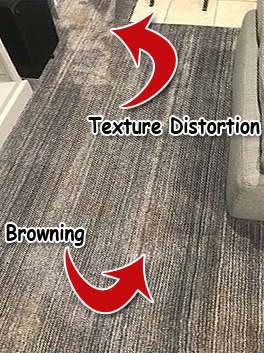
Viscose may be present alone in a carpet's construction, or it may be blended with wool. Be very careful if anyone mentions wall to wall wool carpet, as they may not know that they have a blend!
What Should You Do?
#1 - Interview the Customer: Ask what type of carpet they have. Most people will volunteer if they have wool carpet, or something “special”. Viscose is sometimes sold as “Art Silk” or “Bamboo Silk”. (They might just say “Silk”).
#2 - Test the carpet fibers: The “burn test” is often performed in carpet cleaning classes, but rarely practiced in the field. Now is the time to start to perform this simple test if you haven't been routinely doing it before.
#3 - Decide What to do: If you aren't experienced in cleaning natural fiber rugs or upholstery, you likely aren't ready to clean a wall to wall viscose or viscose / wool blend carpet.
#4 - Warn Your Customer: Viscose is difficult to clean, spots are nearly impossible to remove with distortion or color loss, and they must have their expectations altered accordingly.
#5 - Clean With Care: A carpet made of viscose fiber alone should best be cleaned with absorbent compound. A viscose / wool blend may respond to very low moisture/low pH cleaning processes, but that must be done with much qualification and care.
If you would like more information on how to deal with viscose fiber carpets and rugs, email me at [email protected]. I would be happy to share my findings with you.
-------------------------------------------------
For total access to Pembertons eCleanAdvisor, Join Now for less than $20. per month!
Pembertons eCleanAdvisor is dedicated to sharing knowledge with customers and industry friends -- Join Now! For a membership of less than $20.00 per month, which you may cancel at any time, you get uninterrupted access to our private, member's only, eCleanAdvisor site -
Subscribing now ensures that you'll immediately receive access to valuable information you may need for keeping up-to-date with the professional cleaning industry, no matter where you are.


