

 Membergate

Three Essential Products (+ Risks) In Removing Oily Soils from Fabric
How well do you establish a clear understanding with your customer concerning the extent of their problem as well as the risks involved?
Few "first time customers" understand the value of cleaning, and more often than not ask cleaners to restore fabrics that have been allowed to go far too long without maintenance. Letting your customer know that your ability to find the balance between the results the customer wants and your ability to get those results safely sometimes requires diplomacy skills.
What the cleaner has to tactfully tell their customer is, in so many words is this:
"When fabrics become this soiled, the materials we'll need to use to remove the spots and soils might cause color loss, as well as dye, or texture damage. We'll do everything we can to avoid that, but you should know that this is a possibility."
Just saying “the furniture is dirty” is too vague and not helpful. The problem that exists is that skin and hair oil, as well as oily materials from the food we eat and products that condition hair all create a sticky coating that may be difficult to remove and also attracts additional soil.
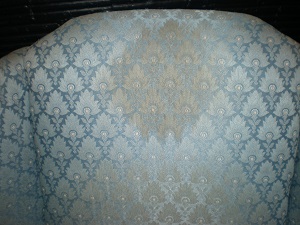
These materials don't only make cleaning more challenging, they also begin to damage dyes in the fabric as well.
Once you have a clear understanding with your customer about the extent of their problem, and what you can do to minimize risks (first) and get the best possible results, it's time to decide how to clean it.
What is required to remove this oily residue is one of the following three cleaning materials.
#1 - Alkaline Builders:
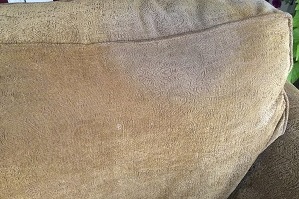
Alkaline builders, when added to a detergent, help to emulsify it so that it more easily rinses away. These same alkaline builders also can cause color bleeding and fading, as well as cellulose browning.
#2 - Solvent Boosters:
Solvent additives can be built into upholstery preconditioning products or added separately. In either case, these products will assist in cutting through oily soils that have bonded to upholstery fabrics. While safer than alkaline builders when it comes to dye fastness, they may also deliver the cleaning solution underneath of the fabrics where dyes may be less stable, or other materials (such as ink markings) may bleed through.
#3 - Oxidizing Agents:
Oxidizing (“bleaching”) agents may be built into the cleaning formula or added separately. These products can decolorize yellow staining caused by oxidized oils and are also effective in breaking down protein films on fabrics.
Some of these products are erroneously called “color safe bleaches”. No bleaching formula is completely “color safe”! The use of these products may contribute to fading, or to over whitening “off white” fabrics.
NOTE: Use them only after thorough testing and qualifying the risks with the customer.
Summary:
Upholstery cleaning specialists should have products that contain these three ingredients, either in a formulated product or as additives. These formulations are essential when cleaning heavily soiled or smoke damaged fabrics and are often safe on synthetic fiber fabrics.
However, it is far better to have upholstery cleaned BEFORE such aggressive chemistry is needed. You can extend the usable life of such fabrics by applying a fluorochemical fabric protector after cleaning.
Fabrics treated by high quality fabric protector will resist oily soiling, and when such soils are present, will release that soil with mild neutral detergents, which means that the colors are more likely to remain bright, dyes less likely to bleed, and browning far less likely to occur.
If you'd like to learn more about how to remove “impossible stains” from delicate fabrics, join us at our next Fabric Pro Workshop.
********************************************
If you'd like learn more about how to clean delicate fabrics, plan to attend our next "Hands On" Fabric Pro Upholstery Cleaning Workshop.
For more information on the Fabric Pro Workshop, CLICK HERE
Coming Soon . . .
******************************
Jim Pemberton's
Fabric Pro Upholstery Specialist Workshop
"Specialist" Course With Extensive "Hands On" Training
Class size is very limited for personal attention purposes, so register today.
Please Join Us Here - December 4 - 5, 2025 in McKeesport, PA
OR January 9 - 10, 2026 in Farmingdale, NY
How Can You Benefit From This?
Click here for complete class details
******************************
Click Here to Register for a class
Next Available Date?
Click Here for The Learning Center Calendar


