

 Membergate

"Real World" Microfiber Upholstery Cleaning Tips for Upholstery Cleaners
Today
I am going to share
a shocking "real world"
soiling story of mine with you!
Its always a challenge to have cushions that have "real world" soiling available for my
"Fine Fabric Care Upholstery Cleaning Workshop".
I usually can find some dirty cushions by asking friends and employees for contributions and by the occasional "dumpster diving" exercise, but rarely do these cushions relate exactly to the problem fabrics I want the students to learn how to clean.
On an impulse, I made up and "lent" three problem fabric cushions to a family I know. I asked them to replace the three cushions on their family room couch with one each of the three different types of cushion.
What surprised me most was that of the three, the most heavily soiled and spotted cushion was the polyester microfiber! All three cushions have some soil and small spots, but the microfiber cushion looks terrible.
It then occurred to me that the reason why this was true was because microfiber upholstery fabric acts very much like microfiber cleaning cloths: It attracts soil and spills! (and holds them!)
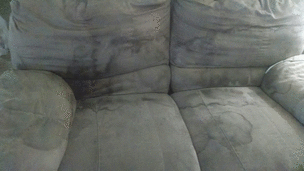
The other issue that makes microfibers so challenging to clean is that most (though not all) are made from polyester fiber. Polyester's oil loving characteristics causes microfiber furniture to rapidly absorb hair and body oil from people and pets, with the resulting "shiny/oily" soiling that coats the arms, upper inside back, and often the cushions.
While polyester is fairly resistant to chemical damage, microfiber fabrics may be made from laminated material that is sensitive to solvent based spotters and cleaners, and should be inspected for pre-existing delamination in heavy usage areas.
You should also be very careful in your cleaning tool selection, as some tools can cause permanent distortion in microfiber fabrics.
The best preconditioning agents to use on microfibers are moderately alkaline products designed for upholstery cleaning. These products are safer to use, and just as effective as more aggressive traffic lane cleaners.
While an acidic rinse agent is not necessary for microfiber fabrics to protect against color bleeding or browning, its often better to use such a rinse agent so that the microfiber can dry soft, rather than with the harsh feel an alkaline extraction detergent would leave.
You must always advise your customer that while microfiber furniture is often inexpensive to purchase and appears to be easy to clean, it is made from something very similar to the microfiber cleaning cloths that they see advertised on TV, and that waiting too long to have their "upholstery made from a cleaning cloth" serviced can result in higher cost restoration processes.
*****************************
Coming Soon . . .
******************************
Cam Mayville's Intensive Hands On Rug Training
Presented by Rug Wash Pros-Cam Mayville and Danny Morris
Hosted by Michael Mussallem in Jacksonville, FL
May 2nd & 3rd in Jacksonville, FL
Learn more: rugwashpros.com/education
Contact to Register: Cam Mayville 402-510-0775
******************************
Jim Pemberton's
Fabric Pro Upholstery Specialist Workshop
"Specialist" Course With Extensive "Hands On" Training
Class size is very limited for personal attention purposes, so register today.
Please Join Us Here - July 18 - 19 in Rochester, NY
How Can You Benefit From This?
Click here for complete class details
******************************
Click Here to Register for a class
Next Available Date?
Click Here for The Learning Center Calendar


