

 Membergate

Difficult Spots Don't Always Require Extreme Risks!
They do Require Customer Education!
One of the most difficult stains to remove from delicate textiles is wine. Wine, as well as other substances that contain natural tannin pigments, such as coffee and tea, can create stubborn stains that can be very challenging . . .
When your customer experiences a “disastrous” spill on a delicate textile ( 'fine upholstery fabric or valuable area rug' ), cleaning professionals often ask themselves: “How far can I go without ruining this?
When cleaning synthetic fiber carpet, such stains may be relatively easy to remove with a peroxide based stain remover. These bleaching products are double, sometimes triple the strength of household hydrogen peroxide and are often damaging to the dyes used on natural fibers. In addition, they can actually weaken and split cellulose natural fibers such as cotton, linen, and rayon.
Obviously, the use of such products on natural fiber textiles should be limited, if not avoided altogether.
Tannin Spotters, the Safer Alternative to Bleach.
In most cases, the use of an acidic tannin spotter will remove stains from wine (as well as coffee, tea, cellulose browning, and even urine) without damaging dyes or the fiber itself in the way that strong oxidizing bleaches can.
An acid based tannin spotter is a blend of surfactants and a mild, organic acid. The way that these products work is as follows: The surfactant lubricates and loosens the residue of the spot, while the acid works on the tannin pigment itself to separate it from the fibers.
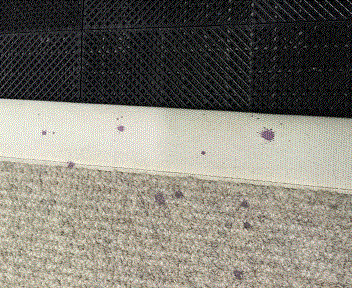
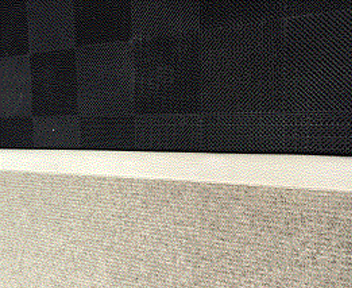
The following two pictures are of a wool area rug that had been stained by red wine, and the result of using an acidic tannin spotter that completely removed the stain without the need for oxidizing bleaches.
How to Remove Wine Using a Tannin Spotter.
(as well as coffee, tea, urine, etc)
PROCEDURE:
First - - Simply Put - - Absolutely Don't Over Promise!
I cannot stress enough how critical it is that you and your staff recognize the importance of clearly establishing reasonable and clearly understood expectations from the very start. There is nothing a customer resents more than a company not delivering what was discussed, agreed upon, and expected.
However, like it or not, most of the time it's our salespersons, technicians, (or owner - managers) who are setting the customer expectations too high, not the customer!
Step #1. Clean The Fabric
In some cases, especially if fabric protector had been previously applied, the tannin stain will come out during cleaning, or at least will be somewhat removed.
Step #2. Apply Tannin Spotter
Mist the stained area with your tannin spotter. You do not need to apply a large volume for it to work.
Step #3. Agitate VERY Gently
Use a soft horsehair brush to gently distribute the spotter and work it into the fibers.
Step #4. Allow Dwell Time
The surfactant/acid blend will not loosen the staining material instantly. Give the spotter a few minutes to work while you clean other areas of the rug/upholstery.
Step #5. Blot
You should see the staining material transfer to a clean white cloth. If this is working, continue to blot until there is no more color transfer.
Step #6. Rinse
The rinsing processes should remove even more discoloration. At this point you will often find that all of the stain has been removed. If more remains, apply more tannin spotter, and repeat steps 3-6.
Step #7. Customer Communication
If there is a remaining stain, discuss the issue with your customer, and allow them to make the choice regarding the use of more potentially destructive stain removers.
Among the reasons you may have residual staining after the use of a tannin spotter could be the length of time the spill remained on the textile, whether or not fabric protector had previously been applied, or the presence of artificial dyes as well as the natural color of the wine.
Some wine manufacturers add artificial color to wine. Should this be the case, the same process used for removing red soft drinks may be used to removal any remaining color, but this too can cause color loss.
Coming Soon . . .
******************************
Jim Pemberton's
Fabric Pro Upholstery Specialist Workshop
"Specialist" Course With Extensive "Hands On" Training
Class size is very limited for personal attention purposes, so register today.
New Date Announced!
August 14 - 15, 2026
Attleboro, MA
New Class Coming to Florida later this year!
How Can You Benefit From This?
Click here for complete class details
******************************
Click Here to Register for a class
Next Available Date?
Click Here for The Learning Center Calendar


