

 Membergate

You BLEACHED My Furniture!!!
Hearing a customer say that on the phone (or texting it to you) is the sort of thing that can ruin your day.
But before you assume that you have actually damaged your customer's furniture fabric, there are a few things you should look at that might prove that what look's like color loss (“bleaching”) hasn't actually had color damage at all, and that condition should be correctable.
What Causes Fabric To Turn White After Cleaning?
Cleaning Agent Residue:
Residues from cleaning detergents may leave a light “haze” to the fabric if it is not thoroughly rinsed. The use of dry solvent spotters and solvent boosters to remove oily spots may create an
emulsion when water based detergents are allowed to dry on the fabric.
The Residue From This Mixture Will Often Dry “white”,
as can be seen in this picture:
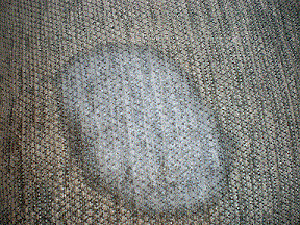
This problem can be remedied by thoroughly rinsing the fabric.
Texture Distortion:
Velvet, Chenille, and other textured fabrics may have areas that look lighter, even bleached, depending on the nap lay and the way it is hit by light. If you didn't groom the fabric properly,
especially if there was an area that had to be spotted or cleaned more aggressively, that area may look lighter, and to your customer, bleached.
You Can See How This Might Appear In This Picture:
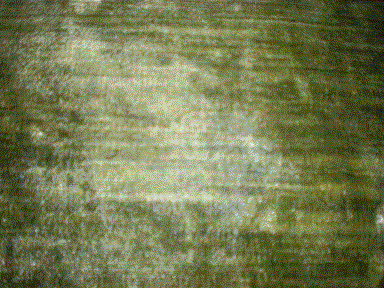
You may be able to correct this problem by re-wetting and grooming the entire panel, or by the use of a steamer and grooming. This potential problem should be discussed with your customer prior to spot removal or even aggressive preconditioning of arms and cushions.
*********************************
There are, of course, times you might have bleached the fabric. However, in most cases, fabrics don't bleach “white”, but instead fade to a lighter color, or lose a primary color, and fade to green,
yellow, rust, etc. One test to do to determine if you actually are seeing color loss is to “wet” the area; in most cases, bleached areas will not change color when wet.
Regardless of the cause of a discoloration that creates concern with your customer, your best course of action is to respond immediately to complaints about your work, and look at the
material without delay.
Very few problems are actually caused by cleaners, but are either pre-existing conditions (such as light or fume fading), or conditions that can contribute to distortion, residues, or actual color loss, such as stains containing dyes or extreme soil conditions.
If you'd like some good ideas on what to look for and how to explain potential problems that you find, look at our Upholstery Condition Report.
I also would like to invite you to
join me at our next Fabric Pro workshop
Class size is very limited for personal attention purposes,
so register today.
Coming Soon . . .
******************************
Jim Pemberton's
Fabric Pro Upholstery Specialist Workshop
"Specialist" Course With Extensive "Hands On" Training
Class size is very limited for personal attention purposes, so register today.
New Date Announced!
August 14 - 15, 2026
Attleboro, MA
New Class Coming to Florida later this year!
How Can You Benefit From This?
Click here for complete class details
******************************
Click Here to Register for a class
Next Available Date?
Click Here for The Learning Center Calendar


