

 Membergate

Why is Upholstery So Much Harder to Clean than Carpet?
Upholstery Fabrics Are Quite Different
From Carpet Floor Coverings!
This statement has been repeated in articles, classrooms and textbooks for years. In many cases, the differences between the types of fibers, constructions, and dyes are the most common aspects that are discussed.
There is another, less mentioned difference that also must be considered when cleaning upholstery:
Upholstery Has Different Soiling And Staining Problems!
Think about how furniture is used today in comparison to its use years ago. If you're over 40, you probably remember a time when you ate only in the dining room at meal times, played outside or in your own bedroom, and slept in your bedroom. Living rooms were only for reading, watching television, or visiting with company.
Today, families and their pets "live" in the living room! People eat snacks and entire meals while watching the television, and children and pets play and sleep on living room furniture.
In many homes, there is now a "family room" for these activities, but the results are the same:
Furniture is soiled and stained in ways never encountered before!
Carpet is manufactured and protected at the factory to protect against such abuse; furniture rarely is protected in this manner. Although there are various protective treatments sold at the retail level, with very attractive guarantees, these products cannot withstand the abuse that most consumers now give their furniture.
Let's examine some of these soiling factors more closely, and how they differ from carpet:
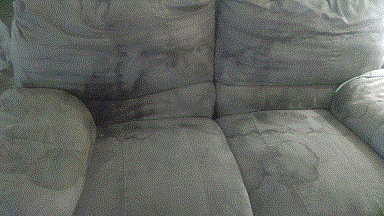
#1. Oily Soils:
Although oily soils are tracked into homes as well, most of these are caught by walk off mats, and generally are from synthetic oils.
Furniture is exposed to a far higher degree of body oils, both from humans and animals. These oils require thorough preconditioning with specialty furniture preconditioning products.
In most cases, upholstery preconditioners are blends of both solvents and moderate pH detergents. Unlike traffic lane cleaners, an upholstery preconditioner usually has a lower, and therefore safer, pH and a higher solvent content to break down these body oils.
#2. Perspiration:
Stains from perspiration are both difficult to remove and may cause damage to many fibers.
Perspiration causes fabrics to turn yellowish brown and contains proteins that may require enzymes for complete removal.
The salts in perspiration may cause serious damage to silk, and also weaken other fibers, though not as severely.
Yellowish discolorations on the arms of furniture may be from either oxidized body oils, perspiration, or both! Best results come with the use of oxidizing agents, enzymes, and/or aggressive furniture preconditioning formulas.
NOTE: Test these products and let the customer know that
permanent staining or color loss may have already occurred.
#3. Hair:
Human and animal hair are deposited both on carpet and upholstery, but hair can be more difficult to remove from woven fabrics, as the hair is held more tightly in these constructions.
Hair can be extremely difficult to remove if the technician does not use lint rollers, brushes, and vacuuming before the application of any cleaning agents.
#4. Cosmetics:
In today's society, mom (as well as dad) comes home from a hard day of work and may lie down on the furniture and take a nap!
This possibility, as well as last minute make-up applications, often means that you are more likely to have to remove cosmetics from furniture than carpet.
CAUTION: At one time, the only way to remove cosmetics (make up, eye liner, eye shadow, lipstick, nail polish) was with the use of dry solvent spotters. However, solvent spotters may damage back coatings on fabric, so be sure to inspect and test carefully before you begin any spotting procedures. Today there excellent water based spotters that often work on cosmetic, ink, and other spots that once could only be treated with solvent based spotter.
These are only a few examples of the different soiling and staining problems that you might encounter in upholstery cleaning.
You must remember to always approach upholstery as a completely different product than carpet, both in its construction and its soiling factors. By doing so, you will be more successful in your cleaning results and have more satisfied customers as well!
Coming Soon . . .
******************************
Jim Pemberton's
Fabric Pro Upholstery Specialist Workshop
"Specialist" Course With Extensive "Hands On" Training
Class size is very limited for personal attention purposes, so register today.
October 9 - 10, 2026
Gainesville, FL
How Can You Benefit From This?
Click here for complete class details
******************************
Click Here to Register for a class
Next Available Date?
Click Here for The Learning Center Calendar


