

 Membergate

BEWARE!! "Their CRISIS" Can Easily Become "Your DISASTER"!
'SALVAGE CLEANING' OF UPHOLSTERY:
There are times when customers who either do not understand how to properly care for their furniture, or who have had a serious “event”, (accidental or massive spill, body discharges, or flood/fire type disaster) that has created a crisis situation, will give you a call for help!
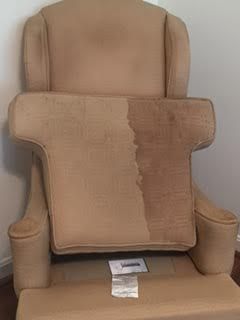
Calls like this can present an incredible challenge for you, the cleaning professional.
When you are presented with a fabric that is extremely soiled, stained, or has had a massive amount of liquid spills, body discharges, water damage, or smoke damage, you need to take the following steps to keep “their crisis” from becoming “your disaster”:
1. INSPECTION AND COMMUNICATION:
At this point, you have to determine the following things:
a. What happened to it?
b. What do they expect you to do about it?
c. What can happen if you try to clean it?
d. What will they do if something goes wrong?
e. Is it worth it to you to try to clean it?
You will get answers a. b., and c. by asking questions, by identifying the type of fabric you are cleaning, by testing for the fiber family, and by looking for permanent damage, as well as damage potentials that exist if you try to restore the fabric.
You will need to talk to your customer in the clearest of terms regarding these first three questions and determine if they are willing to accept the fact that the furniture is likely already ruined, and that your attempts to salvage the situation could make things worse, though you will try not to let that happen.
If their response to “d” is satisfactory, you still have to determine if your attempt to restore the fabric can be accomplished at a profit. If you establish that you can, you should then proceed with the next steps.
2. DRY SOIL REMOVAL:
Vacuum everything as thoroughly as possible. Neglected fabrics will be loaded with skin dander and debris that may interfere with your cleaning products and occasionally result in wicking.
3. PRECONDITION:
If the fabric is synthetic and colorfast, you can use alkaline pre-conditioners, solvent boosters and oxidizing agents. Remember that some of these products may cause color loss, so only use them with a thorough understanding with your customer that some dye may come out with the soil.
WARNING: Heavily soiled items often have preexisting color damage that won't be readily seen until after cleaning.
If the fabric is made from natural fibers, you should consider doing any salvage cleaning in plant, and limit the use of alkaline agents and
instead focus on oxidizing agents and solvent boosters.
Browning, color damage, water marks, and texture damage are all significant risks when attempting salvage cleaning of natural fiber fabrics.
4. EXTRACT THOROUGHLY:
Fabrics that are loaded with suspended soil and aggressive preconditioning formulas need to be rinsed well.
5. DRY QUICKLY:
When you are forced to use aggressive preconditioning formulas and a great deal of moisture to rinse everything out, slow drying can contribute to browning, bleeding, and water staining.
Drying related issues are another reason to clean natural fiber fabrics in plant, where the availability of air movement and humidity control devices can be more easily used, and the drying process can be better monitored.
6. “RECLEAN/TOUCH UP”:
Most heavily soiled fabrics, whether made from natural or synthetic fibers, need a second cleaning after drying. It is nearly impossible to get perfect results with one cleaning. Once again, cleaning such fabrics in plant, when possible and practical, makes more sense.
Consider all of these issues before you decide to be a hero and try to tackle something that has been abused or in a disaster. Your risks will be high, your labor and material costs will be high, and you will need to be paid accordingly.
*************************
For some additional information regarding salvage level cleaning,
eCleanAdvisor members can check out the following links:
Water Damaged Furniture Salvage Tips
https://www.ecleanadvisor.com/members/998.cfm
Four Reasons To Be Cautious With Heavily Soiled Rayon
https://www.ecleanadvisor.com/members/1040.cfm
Problems With Stains That Damage Fabrics And Dyes?
https://www.ecleanadvisor.com/members/1090.cfm
Remove The Customers "Cognitive Blinders"
https://www.ecleanadvisor.com/members/948.cfm
**************************************************
Memo to our Valued CleanTip readers: eCleanAdvisor Membership Has its Advantages - - - -
For total access to Pembertons eCleanAdvisor, CLICK & Join Now before rates go up!
Pembertons eCleanAdvisor is dedicated to sharing knowledge with customers and industry friends -- Join Now! For a membership of under $20.00 per month, which you may cancel at any time, you get uninterrupted access to our private, member's only, eCleanAdvisor site -
Joining now ensures that you'll immediately receive access to valuable information you may need for keeping up-to-date with the professional cleaning industry, no matter where you are.
Coming Soon . . .
******************************
Jim Pemberton's
Fabric Pro Upholstery Specialist Workshop
"Specialist" Course With Extensive "Hands On" Training
Class size is very limited for personal attention purposes, so register today.
Please Join Us Here - December 4 - 5, 2025 in McKeesport, PA
OR January 9 - 10, 2026 in Farmingdale, NY
How Can You Benefit From This?
Click here for complete class details
******************************
Click Here to Register for a class
Next Available Date?
Click Here for The Learning Center Calendar


